
← Horses and donkeys
H31-05 · Module 5 of 7 · Pages: 18 · Worksheets: 5
Tack and harness
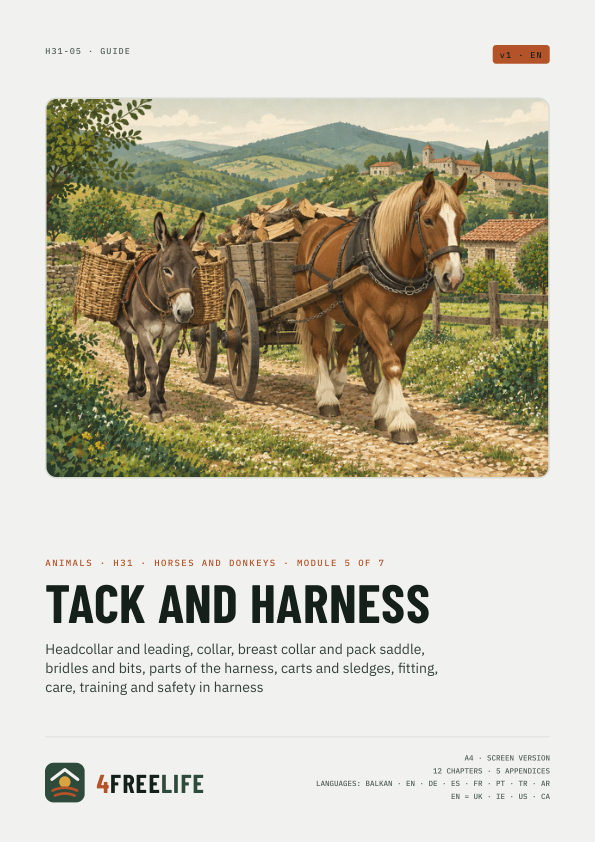
Headcollar and leading, collar, breast collar and pack saddle, bridles and bits, parts of the harness, carts and sledges, fitting, care, training and safety in harness
Secure checkout with Stripe · VAT included · The PDFs are in the language of this page.
Whole series: Horses and donkeys, €39
In short
- Every animal has its own headcollar and lead rope, and learns to lead and stand tied before anything else.
- A collar or breast collar fitted to the horse. A flat hand must fit between the collar and the windpipe, and fingers at the side of the neck.
- A donkey carries roughly up to 20 % of its body weight on a good track (180 kg = roughly 35 kg, about 77 lb), less on steep ground and in heat.
- The order: put the harness on first, then the vehicle; when taking out, vehicle off first, then the harness. Never the other way round.
- A horse in harness is never left alone, not tied, not for a minute.
- A horse that doesn't know harness work learns with an experienced trainer, not in the woods with a log on day one.
What's inside
Chapters
- Basic tack for every animal
- Headcollar, lead rope and tying up
- Collar, breast collar and pack saddle
- Bridles and bits
- Parts of the harness
- Carts, sledges and implements
- Fitting and caring for tack
- Training horses and donkeys for harness
- Safety in harness
- Buying second-hand tack
- Common mistakes
- Printable checklist
Worksheets
- Tack list and condition
- Measuring your animal for tack
- Pre-use tack check
- Load calculator
- Tack and training calendar
Fields and checkboxes can be filled in with Adobe Acrobat Reader (desktop and mobile), and the calculator adds up by itself. Filling in may not work in some browsers. A print version comes with the screen PDF.
This guide in other languages: