
← Energy
H61-03 · Module 3 of 7 · Pages: 21 · Worksheets: 7
Batteries and inverters
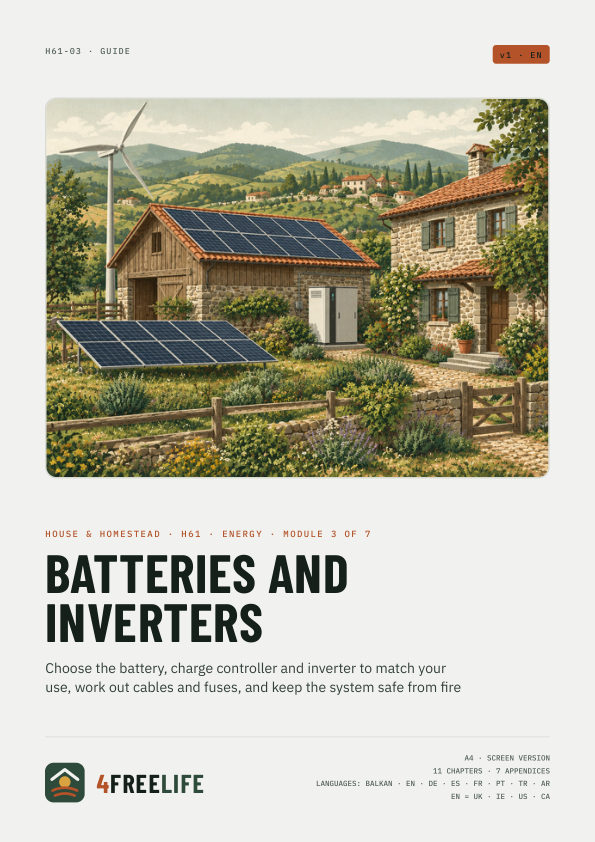
Choose the battery, charge controller and inverter to match your use, work out cables and fuses, and keep the system safe from fire
Secure checkout with Stripe · VAT included · The PDFs are in the language of this page.
Whole series: Energy, €39
In short
- Work out capacity in Wh, not just Ah: Wh = Ah × voltage. Only 50 % of a lead-acid and 80–90 % of a LiFePO4 battery is usable.
- LiFePO4 lasts roughly 3,000–6,000 cycles, a solar lead-acid battery 1,200–2,500. Per cycle, lithium is now usually cheaper.
- Above roughly 1,500 W go to 24 V, above 3,000 W to 48 V: less current, thinner cables, smaller losses.
- The inverter must be pure sine wave, with continuous power 25 % above your load and surge power for the biggest motor.
- A fuse right next to the battery positive is a must. A battery short circuit melts tools and sets cables alight.
What's inside
Chapters
- What a battery does and how it is measured
- Lead-acid or LiFePO4
- How much battery you need
- System voltage: 12, 24 or 48 V
- Charge controller: PWM and MPPT
- The inverter
- Cables, fuses and switches
- Where the battery goes: safety
- Charging, maintenance and life
- Common mistakes
- Printable checklist
Worksheets
- Battery capacity
- Inverter size
- Cables and fuses
- System diagram
- Battery log and maintenance
- Labels for the battery and isolator
- Battery calendar
Fields and checkboxes can be filled in with Adobe Acrobat Reader (desktop and mobile), and the calculator adds up by itself. Filling in may not work in some browsers. A print version comes with the screen PDF.
This guide in other languages: