
← Soil: cultivation and preparation
H02-03 · Module 3 of 7 · Pages: 20 · Worksheets: 5
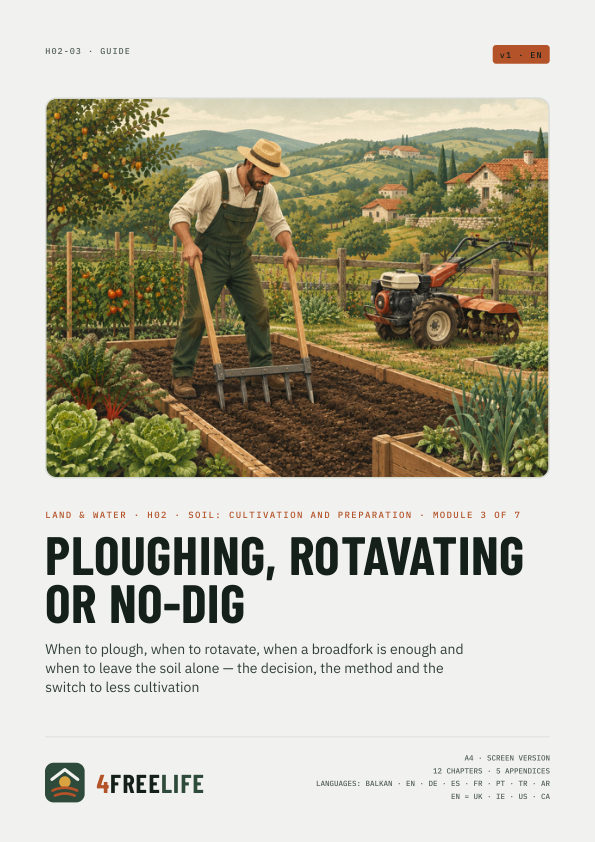
Ploughing, rotavating or no-dig
When to plough, when to rotavate, when a broadfork is enough and when to leave the soil alone — the decision, the method and the switch to less cultivation
€9
Secure checkout with Stripe · VAT included · The PDFs are in the language of this page.
Whole series: Soil: cultivation and preparation, €39
In short
- Never work wet soil. Ball test: if the soil smears into a ribbon, wait.
- Ploughing is for fields and for first breaking grassland; heavy clay is ploughed in autumn, so the frost can crumble it.
- Rotavate at most once or twice a year, and slowly; frequent rotavating makes dust and a hard pan.
- A broadfork loosens to 30–40 cm without turning the layers or killing earthworms.
- No-dig: cardboard and 10–15 cm of compost in the first year, then 3–5 cm a year.
What's inside
Chapters
- What cultivation gives, and what it takes
- When the soil is ready to work
- Ploughing
- Rotavating
- Digging by hand
- Loosening without turning
- No-dig
- Final seedbed preparation
- How to choose
- Switching to less cultivation
- Common mistakes
- Printable checklist
Worksheets
- Cultivation decision for each area
- Compost and labour calculator
- Cultivation and yield log
- Three-year switch plan
- Cultivation calendar
Fields and checkboxes can be filled in with Adobe Acrobat Reader (desktop and mobile), and the calculator adds up by itself. Filling in may not work in some browsers. A print version comes with the screen PDF.
This guide in other languages: