
← Animal feed
H33-01 · Module 1 of 7 · Pages: 21 · Worksheets: 5
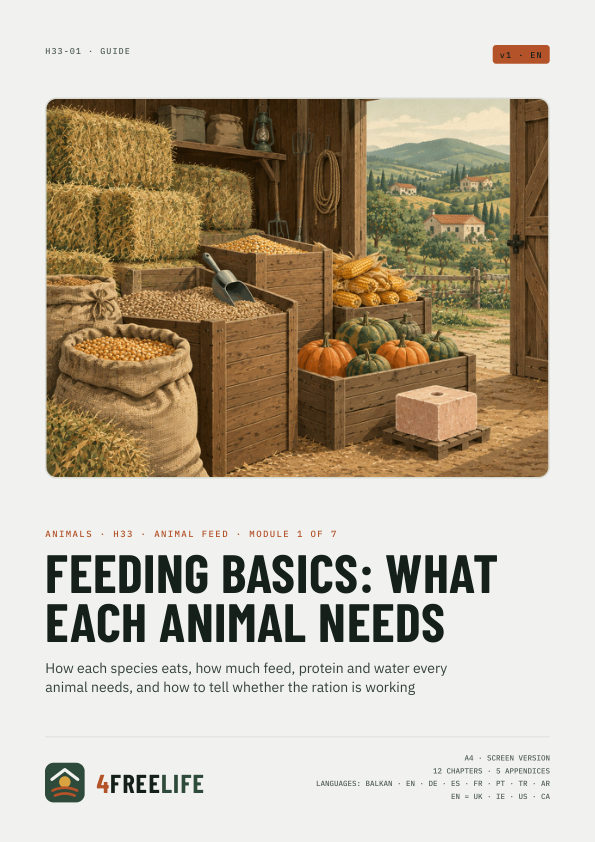
Feeding basics: what each animal needs
How each species eats, how much feed, protein and water every animal needs, and how to tell whether the ration is working
€9
Secure checkout with Stripe · VAT included · The PDFs are in the language of this page.
Whole series: Animal feed, €39
In short
- Three groups of animals eat in three ways: ruminants (goat, sheep, cow) live on hay and grazing, pigs and poultry need grain and protein, and rabbits and horses need fibre.
- Protein is the most common shortfall: a laying hen needs 16–18 %, a chick 20–22 %, while maize (corn) has only about 8–9 %.
- Every change of feed is gradual: ruminants 7–10 days, poultry and pigs 5–7 days, rabbits up to 2 weeks.
- Water is the first feed: a hen 0.3 L, a goat 6 L (a milker up to 15 L), a cow up to 100 L (26 US gal) a day.
- Mould, raw beans, green potatoes and kitchen waste (even meat-free) never go into the ration of animals that produce food.
- You check the ration by hand and by eye: condition, droppings, feathers or coat, eggs and milk.
What's inside
Chapters
- What feed is made of
- Three ways of digesting
- What each animal needs
- Feedstuffs: what's what
- How to read a feed label
- Changing feed
- Water: the first feed
- Condition: how you know the ration is working
- Safety: red lines
- Feeding through the year
- Common mistakes
- Printable checklist
Worksheets
- Daily and yearly feed calculator
- Ration log
- Condition and weight
- Feeding calendar
- Shopping list and questions for the feed merchant
Fields and checkboxes can be filled in with Adobe Acrobat Reader (desktop and mobile), and the calculator adds up by itself. Filling in may not work in some browsers. A print version comes with the screen PDF.
This guide in other languages: