
← Drying
H51-03 · Module 3 of 7 · Pages: 19 · Worksheets: 6
Wood-fired and solar dryers
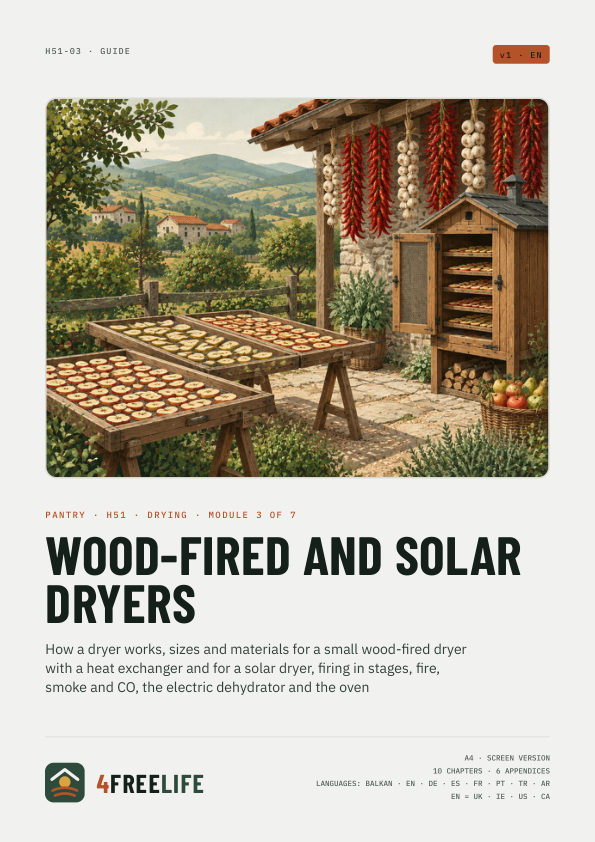
How a dryer works, sizes and materials for a small wood-fired dryer with a heat exchanger and for a solar dryer, firing in stages, fire, smoke and CO, the electric dehydrator and the oven
€9
Secure checkout with Stripe · VAT included · The PDFs are in the language of this page.
Whole series: Drying, €39
In short
- Every dryer works the same way: cool air comes in at the bottom, warms up, passes through the trays and leaves at the top with the moisture.
- In a wood-fired dryer the smoke goes through the heat-exchanger pipe into the chimney, not through the food: no soot, tar or CO in the chamber.
- On the trays fruit 55–65 °C, vegetables 50–60 °C; the bottom tray is the hottest, so the trays are swapped every 2–4 hours.
- A wood-fired dryer stands on its own, on a non-combustible base, away from hay and the woodshed, with a fire extinguisher, and is never left burning unattended.
- A solar dryer with 2–3 m² of collector dries 10–20 kg of fresh fruit in 2–3 sunny days, with no fuel cost.
What's inside
Chapters
- How a dryer works
- A small wood-fired dryer: building it
- Firing and running a wood-fired dryer
- Fire, smoke and carbon monoxide
- Solar dryer: the direct box
- Solar dryer with a collector
- Electric dehydrator, oven and range
- Maintenance and end of season
- Common mistakes
- Printable checklist
Worksheets
- Building and season calendar
- Dryer cost sheet
- Capacity and electricity
- Firing log
- Pre-firing check
- Dryer sketch
Fields and checkboxes can be filled in with Adobe Acrobat Reader (desktop and mobile), and the calculator adds up by itself. Filling in may not work in some browsers. A print version comes with the screen PDF.
This guide in other languages: