
← Smoking and the smokehouse
H52-03 · Module 3 of 7 · Pages: 18 · Worksheets: 5
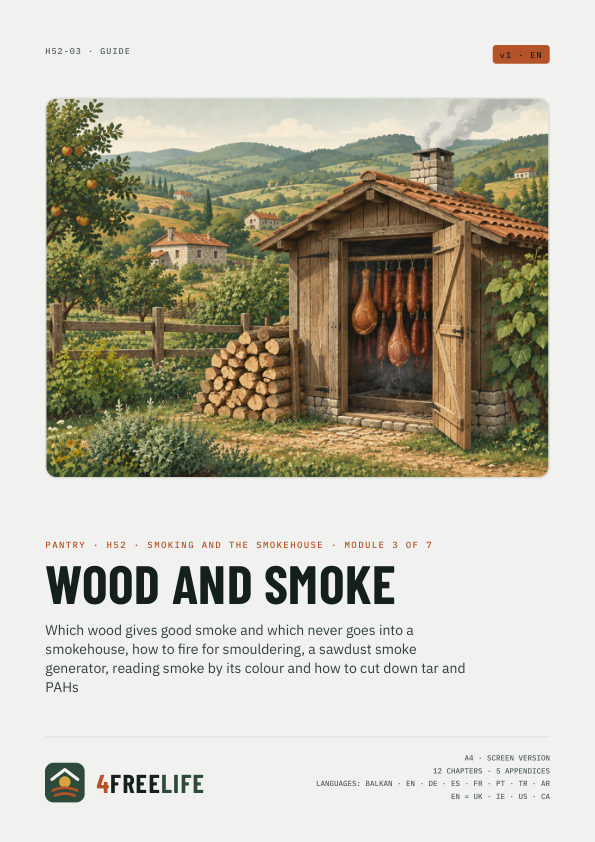
Wood and smoke
Which wood gives good smoke and which never goes into a smokehouse, how to fire for smouldering, a sawdust smoke generator, reading smoke by its colour and how to cut down tar and PAHs
Secure checkout with Stripe · VAT included · The PDFs are in the language of this page.
Whole series: Smoking and the smokehouse, €39
In short
- The best smoke forms when wood smoulders at roughly 300–400 °C (570–750 °F), without flame. Flame and a hot fire make more tar and PAHs.
- For smoke: beech, hornbeam, oak, ash, hickory, maple and fruitwoods (apple, plum, cherry, pear); alder for fish.
- Never: pine, fir, spruce and other resinous softwoods, varnished, painted or treated wood, chipboard, plywood, pallets or mouldy wood.
- Wood seasoned for 1–2 years; sawdust dry to the touch. Wet wood gives thick, bitter smoke.
- Good smoke is thin, bluish or greyish. Thick white, yellow and black smoke mean something is wrong.
- A sawdust smoke generator gives 8–12 hours of cool, even smoke from one filling.
What's inside
Chapters
- From wood to smoke
- Which wood for smoke
- Wood that never goes into a smokehouse
- Forms of wood
- Firing for cold smoke
- The sawdust smoke generator
- Smoke for hot smoking
- Reading the smoke
- Tar and PAHs: how to cut them down
- Getting and storing wood
- Common mistakes
- Printable checklist
Worksheets
- Smokehouse wood card
- Wood and sawdust calculator
- Wood calendar
- Wood and smoke log
- Labels for wood and sawdust
Fields and checkboxes can be filled in with Adobe Acrobat Reader (desktop and mobile), and the calculator adds up by itself. Filling in may not work in some browsers. A print version comes with the screen PDF.
This guide in other languages: