
← Salting and brining
H53-07 · Module 7 of 7 · Pages: 21 · Worksheets: 8
Safety and checks
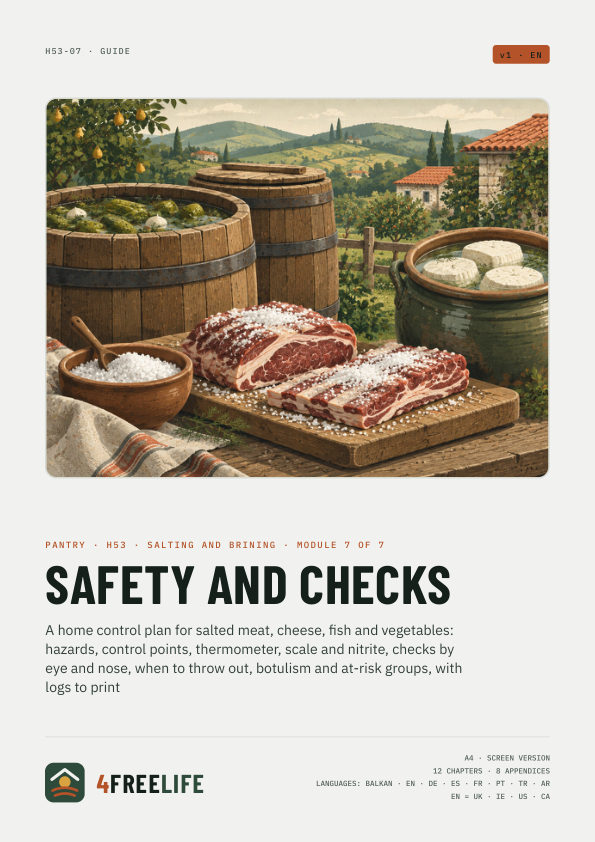
A home control plan for salted meat, cheese, fish and vegetables: hazards, control points, thermometer, scale and nitrite, checks by eye and nose, when to throw out, botulism and at-risk groups, with logs to print
€9
Secure checkout with Stripe · VAT included · The PDFs are in the language of this page.
Whole series: Salting and brining, €39
In short
- Five control points: raw material, cold, salt and nitrite, time, finished product. Each has a limit and a measure.
- Thermometer and scale are checked before the season: the thermometer in iced water shows 0 °C (32 °F), and the scale shows 1,000 g for 1 L of water.
- Nitrite: at most roughly 80 mg per kg of meat in this series (Regulation (EU) 2023/2108; check the rules where you live). Arithmetic: g of curing salt × % nitrite × 10 = mg per kg.
- When in doubt, throw it out. Don't taste suspect food, don't give it to animals and don't "save" it by cooking.
- Botulism: double vision, drooping eyelids, difficulty speaking and swallowing. Call 999/112 (UK, Ireland) or 911 (US, Canada) at once.
- Pregnant women, babies, small children, the elderly and the ill eat salted meat, fish and white cheese only cooked.
What's inside
Chapters
- What can go wrong
- Five control points
- Thermometer and scale
- Nitrite: arithmetic, limit and storage
- Checks by eye and nose, and when to throw out
- Botulism: signs and what to do
- Who doesn't eat raw salted food
- Traceability: batch, label, log
- Giving and selling
- The yearly check
- Common mistakes
- Printable checklist
Worksheets
- Control point plan
- Nitrite calculator
- Temperature log
- Equipment check log
- "When to throw out" chart
- Check calendar
- Emergency contacts
- Labels for curing salt
Fields and checkboxes can be filled in with Adobe Acrobat Reader (desktop and mobile), and the calculator adds up by itself. Filling in may not work in some browsers. A print version comes with the screen PDF.
This guide in other languages: