
← Cooling without electricity
H57-06 · Module 6 of 7 · Pages: 18 · Worksheets: 6
Evaporative cooling
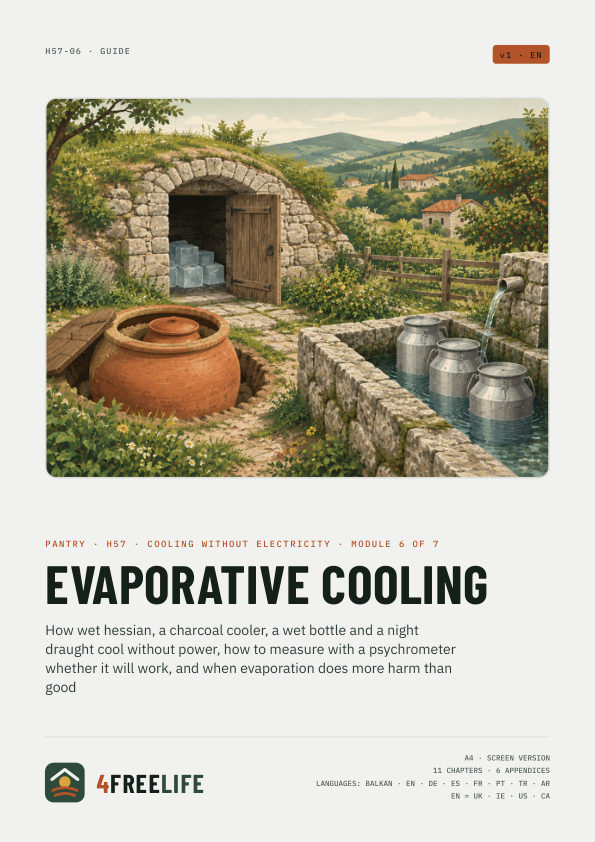
How wet hessian, a charcoal cooler, a wet bottle and a night draught cool without power, how to measure with a psychrometer whether it will work, and when evaporation does more harm than good
Secure checkout with Stripe · VAT included · The PDFs are in the language of this page.
Whole series: Cooling without electricity, €39
In short
- Evaporation cools at most to the wet-bulb temperature. On a dry day (30 °C, 30–40 % humidity) that is 18–20 °C; on a muggy one (70 %) only 25–26 °C.
- Two thermometers, one with a wet wick, show in advance how much cooling you can get. A difference below 4 °C: do not bother.
- In a typical British or Irish summer the difference is often only 3–6 °C; in the dry American West and the Prairies 10–15 °C.
- It needs shade, a draught and a surface that is always wet. A closed, muggy space does not cool.
- Evaporation is for vegetables, fruit, greens, water and drinks. Not for meat, milk or cooked food (H57-01).
- Wet surfaces must be dried and cleaned: mould, mosquitoes and stale water are the price of this method. Water in sprayers and tanks is changed every 2–3 days.
What's inside
Chapters
- How evaporation cools
- Wet-bulb table
- The psychrometer: measure before you build
- Water and drinks: bottle, bag and jar
- The charcoal cooler
- A wet-hessian cabinet
- Vegetables after harvest: field cooling
- Cooling a pantry or summer kitchen
- When evaporation does not work or does harm
- Common mistakes
- Printable checklist
Worksheets
- Water and materials calculator
- Psychrometer log
- Comparison test of devices
- Charcoal cooler sketch
- The evaporative cooling season
- Cost sheet and buying
Fields and checkboxes can be filled in with Adobe Acrobat Reader (desktop and mobile), and the calculator adds up by itself. Filling in may not work in some browsers. A print version comes with the screen PDF.
This guide in other languages: